PENANG, MALAYSIA – As a self-professed foodie and lover of all things edible, one of the most interesting parts of travelling long-term is that you get to see local foods come in and out of season, just like at home. When I was in Penang earlier this year, I wrote Part One of Tropical Fruits I Have Known, which explored fruits popular in the New Year season. Now that I am back in Penang and again exploring the local wet markets, I have discovered a whole new season of fruit to learn about and celebrate.
Prepare yourself to drool over six new tropical fruits that I have known and loved, and that I hope you will love too.
1. Rambutan
Looking more like a character from a Dr. Seuss book than something edible, rambutan grow on trees around the communities of Penang. These rambutan were graciously delivered to me by a friend whose neighbour has a tree full of the little ripe fruit! The fruit inside looks nothing like the outside, and is a clear, sweet fruit much like a longan or lychee. There is a large seed inside each of these babies, so make sure to eat carefully and save those seeds to plant next year!
How to eat it: Although the rambutan looks spiny and unfriendly, it won’t hurt you. The easiest way to open one up is to grab a paring knife, make a slice around the circumference, and use your thumbs to pop it open. Local wisdom says you shouldn’t eat rambutan in the evenings (although I’m not entirely sure why) so tuck into your fruit during the daytime as a dessert or afternoon snack.
Recommended uses: You will often find rambutan fruit peeled and canned, or turned in jellies in jars. Although they stand up pretty well in a tin, my favourite way to eat them is fresh.


2. Cempedak
Warm weather year-round means much longer growing seasons than we are used to in Canada. Consequently, this means much larger fruit! Cempedak is similar to jackfruit or durian, and grows in a massive pod the size and weight of a dog or small child. The outside looks like lizard skin, and if you saw one of these on the side of the road, you would not be amiss in mistaking it for an armadillo. Inside, the fruit comes in soft yellow sections, each with a hard seed inside. The taste is quite strong, with a cloying sweetness and a kind of durian-esque aroma.
How to eat it: Unless you need to feed an army, chances are you won’t ever need to buy a whole cempedak. Any vendor selling these will have cut one open and will be selling containers with a few sections inside. No fuss, no muss!
Recommended uses: Although the fruit can be eaten fresh, a very popular way to eat this in Penang is cempedak goreng, which is whole sections dipped in batter and then deep-fruit like a little doughnut. Be careful when you eat them though, they fry them with the seeds still inside!

3. Custard Apple, or Sweetsop
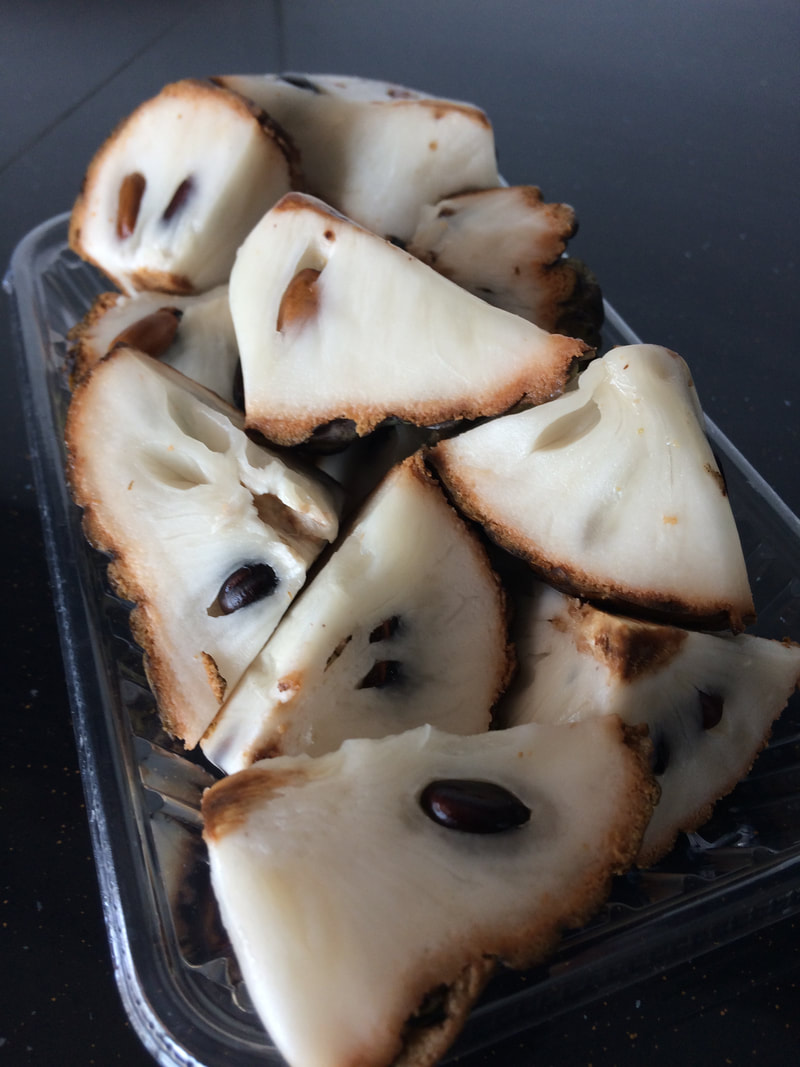
This is the apple with many names…commonly known as the custard apple, sugar apple, sweetsop, ata, and something else that the seller at the market told me (but I couldn’t quite understand). The custard apple looks like a pinecone or alligator egg on the outside, but inside it is smooth and white. The flesh tastes sweet and custard-y, and the texture is smooth and wet like other latex fruits. When I tried this for the first time, I was surprised by how delicate the flavour is, compared to how aggressive the outside appears.
How to eat it: Cut it into wedges much like a traditional apple. The inside is riddled with big black seeds which look similar to watermelon seeds only larger. Don’t eat the seeds! They are toxic unless cooked specially for consumption. Once your fruit is in wedge-form, poke the seeds out and cut the fruit off the skin.
Recommended uses: Like most fruits, this one is great fresh on its own. The soft interior also makes a nice spread on buttered toast.


4. Soursop
The soursop is much like the sweetsop, only bigger and (you guessed it) sour! The texture is a little more firm than the sweetsop, but similarly latex-y in nature.
How to eat it: Same deal as the sweetsop, cut it into wedges or pieces and poke the seeds out. Then remove the skin and eat up.
Recommended uses: This is another one you can eat fresh, but since it can be quite sour, you may want to treat it a bit more before eating it. A great use of the soursop is in smoothies! The flesh adds a creamy texture when blended, and the sour bite contrasts nicely against sweeter fruits like dragonfruit, orange, or banana.
5. Belimbing, or Starfruit
Belimbing may be one of the prettiest fruits out there. Not when it’s whole, of course, because it looks like a lumpy plastic football…but when it is cut the cross-sections form beautiful 5-point stars. The fruit itself is quite crisp and watery, and tastes fresh, tart, and bright.
How to eat it: Give your fruit a good wash, as the slightly mottled skin of the starfruit is perfect for waxy buildup, spider webs, and other unpleasantness. Then simply slice it into thin stars. There will be a few small seeds inside, so poke those out with a knife before serving.
Recommended uses: Belimbing is so pretty, I basically think it should go on top of everything as-is. Put it on any salad, smoothie bowl, cheese board, dessert, breakfast, or serve alone as an afternoon snack. If you’re really looking to impress, saute it briefly in a little butter, maple syrup, and cinnamon before putting it atop a stack of pancakes or waffles. The heat will caramelize the sugar just a bit and make it soft and luscious…just be sure you don’t overcook it and have it turn to shapeless mush.


6. Mangosteen
I bet you didn’t know that the mangosteen is such a party animal it often gets banned from hotels! Really though, the purple mangosteen stains like a sumbitch, so it is not encouraged for consumption in hotels, buses, public areas, nor near upholstery or white clothing.
Looking somewhat like a troll’s tomato, the mangosteen is an unassuming fruit until you crack it open. The outer shell is thick and purple, but the fruit inside is surprisingly white, and looks something like a little mandarin orange when exposed. The inner sections of the mangosteen do not taste like mango (misnomer), but are sweet like candy and melt in your mouth.
How to eat it: Put on some black clothes, or clothes you don’t mind staining up. Break into your mangosteens with your thumbs or a knife, and peel off the purple outer layer. Discard the peel and wash the purple off your hands before digging further. Eat the inner white part, but be conscious that some sections (usually the larger ones) will have a seed inside.
Recommended uses: Use the purple outer shell to tie-dye your clothes or stain your deck. Eat the fruit fresh, or use it in place of sweet fruits in baking or other recipes. They are particularly nice on an upside-down cake, as a topping on a chia parfait, and many Asian recipes recommend pairing it with fish, shrimp or shellfish.
Which tropical fruit would you like to try? Share in the comments below.

 The Travel Binder