PENANG, MALAYSIA – One of my favourite pastimes while traveling is to wander the local food markets. I think you can learn a lot about culture, as well as the local cuisine, when you explore the venues where people buy their food. There is how food itself is treated: is it casual or serious? do people shop alone or with friends and family? are meats and vegetables sold in the same place? is there religious custom signified in any of these practices?
There is also the matter of the ingredients you can find. My absolute favourite thing to do at the market is to pick out something that I have no idea what it is, bring it home, and try to make something with it. I think this is a habit that I picked up from my father, who loves to go to the Asian markets back at home in Canada, buy something that isn’t labeled in English, and then try to figure out how to cook it for dinner. So! Let’s dive into my adventures with unfamiliar tropical fruits, shall we?
1. Passion fruit
I picked up this surprisingly lightweight little fruit at the morning wet market. The vendor could only give me the Chinese name, so this one was a mystery for me! Upon further examination (and with the input from a helpful and knowledgable relative) I discovered it is a passion fruit! My only real familiarity with the flavour of this fruit comes from drinking Tropical Five-Alive as a kid, which obviously pales in comparison to the real thing. This fruit is tart and sour, and for such a small thing packs a big flavour!
How to eat it: I tried two methods…first I cut it open, dug in with a spoon, and took a big bite. Although the internet tells me this is a perfectly legit thing to do, I found it rather unpleasant. The fruit inside is quite slimy and full of big seeds. Next, I tried pressing it through a fine sieve to get the juice separated from the innards. This worked much better. One passion fruit yielded about two tablespoons of juice, which isn’t much, but with the strength of the flavour you don’t need much to make an impact.
Recommended uses: I used my passion fruit juice in a papaya smoothie and it was awesome. It added a a sour balance to a sweet drink. Here in Penang, I also had a delectable vegan passion fruit cheesecake at a local vegetarian restaurant. I am also told a little juice tastes great drizzled over coconut ice cream.


2. Jackfruit
Fresh jackfruit is probably my go-to fruit here in Penang. It isn’t cheap, but it’s definitely worth filling up on since it’s not something we can easily get in North America. Jackfruit is a really cool fruit…it grows in a massive spikey pod (much like a durian except larger) and is filled with fruit sections of yellow fruit. To me it tastes quite uniquely tropical, and something about the taste actually hints of banana – specifically the banana-flavoured amoxicillin medicine I used to get as a kid.
How to eat it: Once the fruit is removed from the pod and cleaned (as per the above photo), it is good to go. Just peel the fruit off the big inner seed and munch away.
Recommended uses: You can use jackfruit as you would any fruit, but I’m quite fond of it in it’s whole form. You will also find cooked jackfruit (including the interior pulp) used is many Southeast Asian curries and dishes. If you’re not in a region where you can access fresh jackfruit, I highly recommend picking up some cans of young green jackfruit and using them as a base for some vegan cooking – when stewed, green jackfruit shreds apart into a substance much like pulled pork and is a great filling for tacos. Find one of my favourite recipes for jackfruit brisket in this cookbook.

3. Green Chinese Dates / Jujubes
When the vendor at the market told me these were dates, I was not convinced. These little hard green fruits certainly didn’t look like any date I had seen before! So I brought home a handful and set to researching them online. After a lot of googling, and crowd-sourcing ideas from a very helpful local ex-pat group, I discovered these little guys are called jujubes – or rather the ziziphus jujuba – which I think is just the loveliest name for a little piece of fruit. Colloquially, these are called Chinese dates, Korean dates, or Indian dates, depending on whom you ask.
How to eat it: These dates are edible in both their green and ripe forms. Green, they taste somewhat like a small green apple…quite crisp and tart. You can eat them much like an apple, munch down on the fruit but make sure to eat around the seed core. If you let these dates sit, they will turn red and start to wrinkle up, and quickly turn into a form more recognizable as a date.
Recommended uses: You can munch on these as a snack on their own, however if you chop them up they add a nice texture to salads, smoothie bowls, and soups. You can also substitute them for apples in nearly any recipe that you would like to make a bit more special.

4. Longan
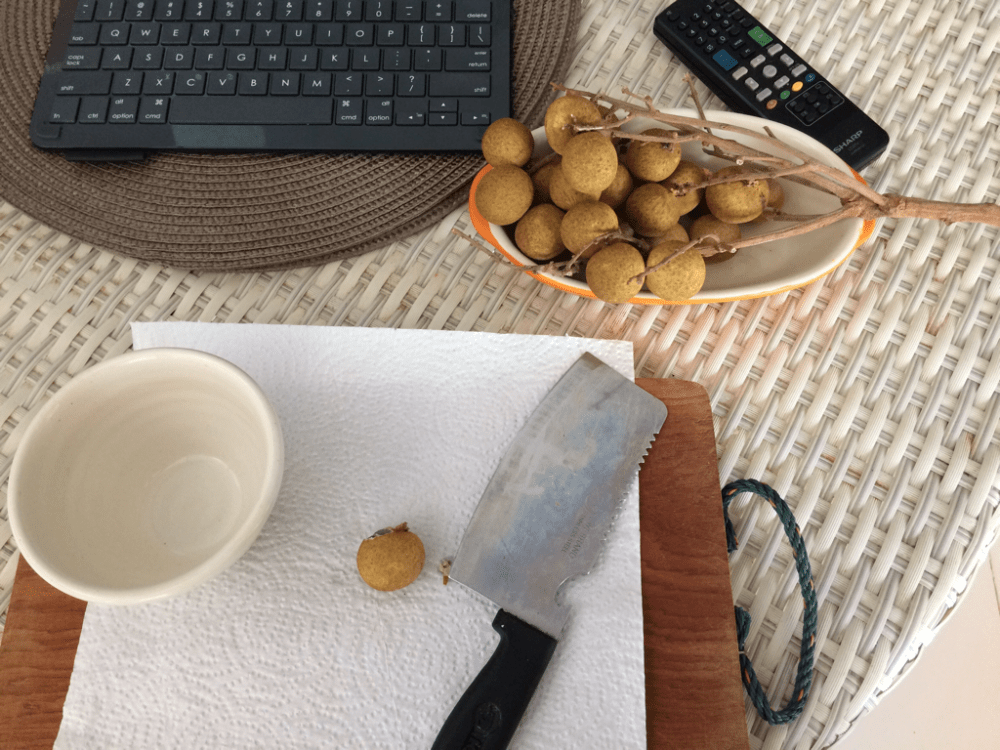
Longan fruit – which I incorrectly called Longan Berries for the longest time – are a wonderful little clear fruit wrapped in a somewhat underwhelming package. The fruit itself is much like a rambutan or lychee, except it comes in a hard little brown shell that grows at the end of a stick. Don’t let this somewhat utilitarian vibe fool you though: longan is sweet and delicious, and every bit as good as its fancy cousins. Once you get through the shell, you’re going to find a translucent, grape-sized fruit with a single hard black seed in the middle.
How to eat it: The outer shell varies in texture depending on the batch. When you peel it, you may be able to easily crack it open with your fingers or by squeezing the shell. The recent batch that I had was pretty tough, so I ended up using a knife to split the shell, and then I peeled it off with my hands. The longan is going to be more difficult to peel if it’s been chilled, so take it out of the refrigerator for a half hour before digging in.
Recommended uses: Since peeling this fruit is a bit of a project, I recommend just peeling it and eating it whole – preferably while chilling on the couch and watching some Netflix (like more complicated popcorn!). For a lark, I highly recommend peeling a bunch and putting them in a bowl to use as eyeballs at a Hallowe’en haunted house. For any drinkers out there, I am also a big fan of using this type of fruit in a cocktail…add it to a mojito or sangria for an extra tropical vibe.
5. Jambu Air
Jambu air translates roughly to English as water apple, although personally I don’t find it very watery or apple-y. Upon a cursory first glance, it actually looks somewhat like a pear, but the waxy deep rose exterior belies a unique inner life. The texture is crisp much like a Chinese apple-pear, and it gives a satisfying crunch. The taste of the mature fruit isn’t overwhelming, but mild and pleasantly sweet. If sour taste profiles are your thing, purchase young jambu air, which are smaller and more of a cotton-candy pink colour, and they will give you the nice nice mouth-pucker you’re after.
How to eat it: Cut it open and remove the inner seed section, and the curled-under bell at the bottom. If you’re feeling lazy, it’s easy enough to eat whole much like an apple.
Recommended uses: I like to eat this one fresh and paired with something salty. A favourite snack of mine is jambu air sections with a bowl of salt and vinegar kettle chips. It’s also a great topping for a smoothie bowl or a salad. Definitely use it for its texture and freshness when using it in a recipe.

6. Dragonfruit…..Purple Dragonfruit
Many North Americans are familiar with the dragonfruit, as in recent years it has become widely available at most supermarkets in the produce section. The inside of these dragonfruit are opaque and white, and dotted with small edible black seeds (much like the seed of a kiwi fruit). However, in Malaysia I discovered the cousin of the dragonfruit with which I am familiar: purple dragonfruit. It looks identical to the white fruit from the outside, however inside it is a bright, almost neon purple dotted with the familiar black seeds. The taste is different from the white variety, which I always thought had a somewhat coffee-like aftertaste, and is sweeter and juicier.
How to eat it: Take off your white shirt. Get a cutting board made of stain-proof material. Dealing with a purple dragonfruit is similar to preparing beets, so make sure you take precautions to minimize staining any nearby surfaces. To open this baby up, slice off the ends, and then run a knife up one side of the peel. Then use your hands to pull off the peel in one big piece. Everything left behind is edible, and you don’t have to worry about big seeds or a core or anything inside blocking your access to deliciousness.
Recommended uses: PUT IT ON EVERYTHING. No really, purple dragonfruit is pretty much the best in most conceivable situations. Put it in a smoothie. Put it on your toast with peanut butter. Use it as a topping for a salad. Make a Dragonfruit Upside-Down Cake. Purée it into your cake/muffin/pancake batter to make naturally brilliant baking. Put it on ice cream. Eat it with a spoon. Enjoy to your heart’s desire.
Have you tried all of the above? Share any questions, thoughts, or recipes in the comments below.


 The Travel Binder